EMG & Motor Intent: Decoding Movement Before It Happens
A wearable EMG bracelet let people with spinal cord injuries, stroke-related paralysis, and limb amputations control a digital hand, robotic brace, or cursor ; often within minutes, even with no visible movement. Here's how the signal is decoded.
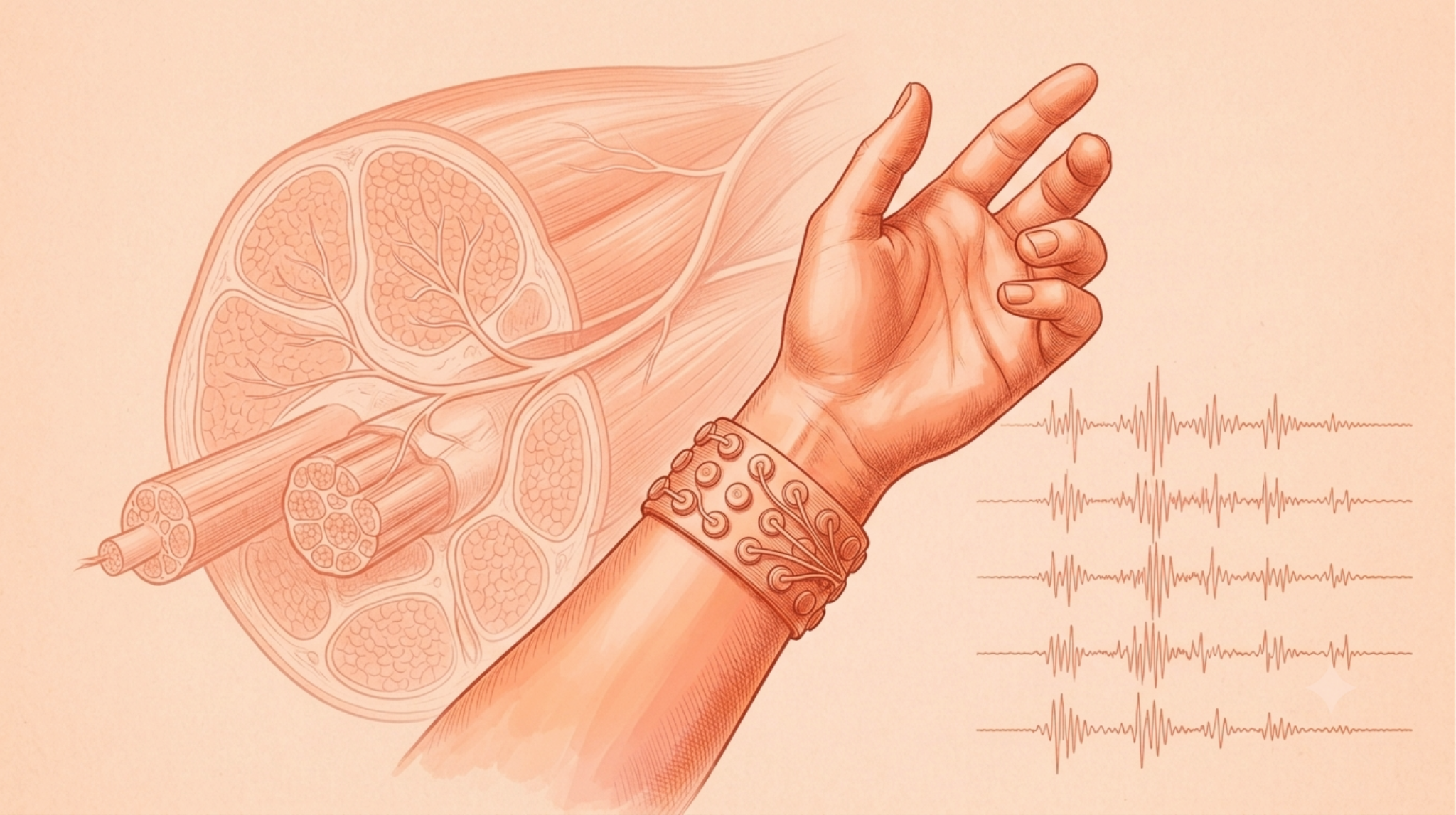
A wearable EMG bracelet let people with spinal cord injuries, stroke-related paralysis, and limb amputations control a digital hand, a robotic brace, or a computer cursor; often within minutes, even when they couldn't visibly move at all.
The problem
When someone loses a limb, or when a stroke or spinal injury damages the nerves that control movement, the brain often still sends the signal to move, the muscle just can't carry it out the way it used to. Older prosthetic hands work around this crudely: a sensor reads one or two remaining muscles and turns the result into a single "open" or "close" command. It works, but it's limited, and it doesn't help someone without enough working muscle left to send a clean signal.
That's the gap surface electromyography (sEMG) is closing. sEMG is a small sensor placed on the skin that picks up the electrical activity a muscle produces when it tries to contract, even a weak or partial attempt that never turns into visible movement.
Why it matters
Every muscle movement starts with a nerve cell called a motor neuron firing an electrical signal into the muscle. An sEMG sensor on the skin picks up the combined electrical "buzz" of many of these signals firing together. The pattern in that buzz, not just whether the muscle fired, but how and in what order, carries information about the specific movement someone is trying to make, not just whether they're trying at all.
Reading that pattern accurately is hard. Sweat, skin condition, and even a slightly shifted sensor can distort the signal. Newer devices use far more contact points - up to 128, instead of the usual 2 to 4 to pick up finer detail, and machine-learning models are proving much better than older methods at turning that detail into an accurate read of the intended movement, including several movements at once instead of just one.
The Evidence
In one 2025 study, researchers built a wireless EMG bracelet and tested it on people with spinal cord injuries, stroke-related paralysis, and limb amputations. In every group, the device picked up enough signal from muscles that still worked, even with no visible movement, to let each person control a digital hand, a robotic brace, or an on-screen cursor, often within minutes of putting it on.
Other recent work is pushing this further: designing sensor hardware specifically for compact, wearable prosthetics; testing whether deep learning genuinely beats older methods on real amputee patients in real time; and even estimating ankle movement from leftover leg muscles after lower-limb amputation: evidence that this approach is expanding well past the hand.
Where this is heading
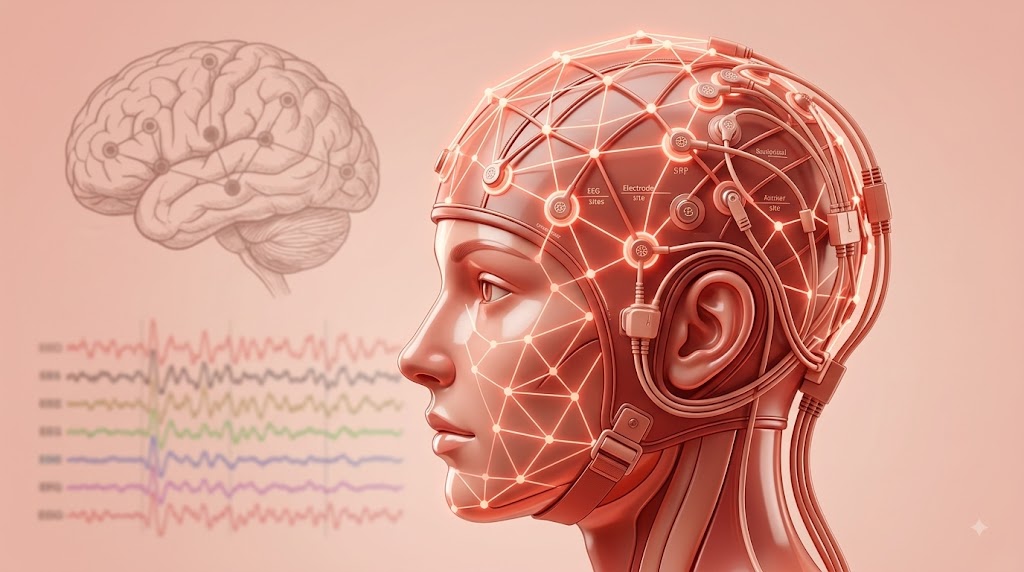
The direction is consistent: from simple on/off control toward richer, multi-part control, and from amputees only toward stroke and spinal-injury patients whose muscles still carry a usable signal. The next step; one that mirrors Anthriq's stroke-rehab research is combining EMG with EEG, pairing the brain's intent signal with the muscle's remaining signal for a more precise, more reliable system.
Know More
[1] MyoGestic: EMG interfacing framework for decoding multiple spared motor dimensions in individuals with neural lesions. PMC. https://www.ncbi.nlm.nih.gov/pmc/articles/PMC11980827/
[2] Advances in HD-EMG interfaces and spatial algorithms for upper limb prosthetic control. Frontiers in Neuroscience, 2025. https://www.frontiersin.org/journals/neuroscience/articles/10.3389/fnins.2025.1655257/full
[3] Deep Learning for Enhanced Prosthetic Control: Real-Time Motor Intent Decoding for Simultaneous Control of Artificial Limbs. PubMed. https://pubmed.ncbi.nlm.nih.gov/38421839/
[4] A Comprehensive Survey of Machine Learning Algorithms in Hand Gesture Recognition for Myoelectric Prosthetic Control. Archives of Computational Methods in Engineering. https://link.springer.com/article/10.1007/s11831-025-10480-9
[5] Ankle Torque Estimation With Motor Unit Discharges in Residual Muscles Following Lower-Limb Amputation. PMC. https://www.ncbi.nlm.nih.gov/pmc/articles/PMC10752569/
[6] Optimized Feature Extraction via Custom Low-Cost sEMG Hardware for Real-Time Myoelectric Interfaces. Engineering, Technology & Applied Science Research. https://etasr.com/index.php/ETASR/article/view/16242
Further reading




Subscribe to Neurotech Pulse
A roundup of the latest in neurotech covering breakthroughs, products, trials, funding, approvals, and industry trends straight to your inbox.