Beyond the heartbeat: What ECG reveals about the brain
Your brain and heart are in constant communication. New research shows a simple heart sensor can now read that connection well enough to estimate mental strain almost as accurately as EEG.
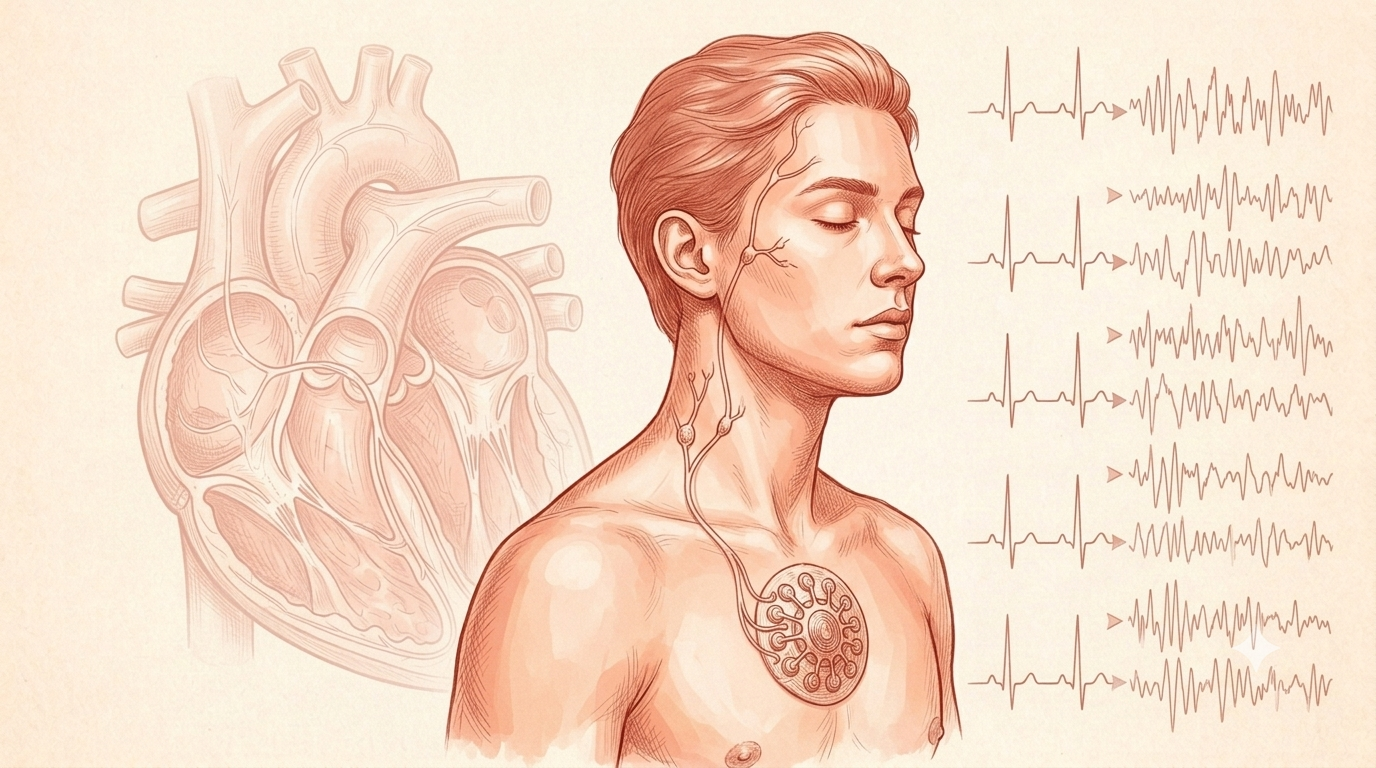
In a 2026 study, a heart-sensor-only model predicted results that normally require an EEG brain-wave sensor with over 98% accuracy, turning a device already built into most smartwatches into a workable stand-in for brain monitoring.
The problem
EEG — a cap of sensors that reads electrical activity straight from the brain, is still the most accurate way to measure things like mental strain and stress. But it's not practical to wear all day: it needs sensors touching the scalp and doesn't hold up well once you're moving around. ECG, the sensor that reads your heartbeat, is already built into smartwatches, chest straps, and fitness trackers worn by millions of people daily. The question researchers have been testing directly: can a heart sensor tell us enough about what's happening in the brain to be useful on its own?
Why it matters
Your brain and heart are in constant communication through the nervous system. When your brain is under strain, that shows up not just in brain waves but in subtle shifts in your heartbeat too. For years, the standard way to read that heart-based signal was heart rate variability (HRV), essentially, how much the time between heartbeats varies. But HRV turned out to be a fairly rough proxy: in one study, an EEG headband correctly identified stress about 81% of the time during a demanding task, while a heart-rate-only model managed just 62%.
That gap has started to close. Instead of relying on simple heart-rate variability, newer research pulls much richer detail out of the raw heartbeat pattern and uses machine learning to translate it into the kind of information EEG normally provides.
In a 2026 study using this approach, a heart-sensor-only model correctly classified mental workload 98.68% of the time, close to EEG's own 99.82%, and predicted the matching EEG reading with over 99% accuracy.
Real-world applications
Researchers built this system around real high-pressure jobs: air traffic control, emergency response, call centers; where continuously tracking someone's mental strain matters, but fitting them with an EEG cap all day isn't realistic. A chest-strap heart sensor is. A separate public dataset, collecting heart-sensor and stress data from people under real exercise and stress conditions, is now helping researchers build and test these kinds of models at scale. In February 2026, researchers formally named this growing field "neurocardiology" the study of how AI-analyzed heart data connects to brain health.

Where this is heading
This doesn't mean heart sensors will replace EEG. But it points to a practical setup: heart sensors, already worn constantly, handling everyday stress monitoring, with EEG reserved for cases that need a more precise, brain-level read. It's the same idea already playing out across stroke rehab and mental-health research. Don't rely on one signal when combining a few gets you further.
Know More
[1] Unveiling the Heart-Brain Connection: An Analysis of ECG in Cognitive Performance. arXiv. https://arxiv.org/abs/2601.01424
[2] Wearable EEG-Based Brain-Computer Interface for Stress Monitoring. PMC. https://pmc.ncbi.nlm.nih.gov/articles/PMC11503304/
[3] Artificial intelligence in neurocardiology: decoding brain-heart network interactions. Frontiers in Neuroscience, 2026. https://www.frontiersin.org/journals/neuroscience/articles/10.3389/fnins.2026.1788653/full
[4] Cross-Modal Computational Model of Brain-Heart Interactions via HRV and EEG Features. arXiv. https://arxiv.org/abs/2601.06792
[5] Why Nonlinear Models Matter: Unified Analysis of Cognitive Load, Stress, and Exercise Using Wearable Physiological Signals. arXiv. https://arxiv.org/pdf/2512.06099
Further reading



Subscribe to Neurotech Pulse
A roundup of the latest in neurotech covering breakthroughs, products, trials, funding, approvals, and industry trends straight to your inbox.